How to show homeowners roof damage they can't see: photos, marks and proof that hold up
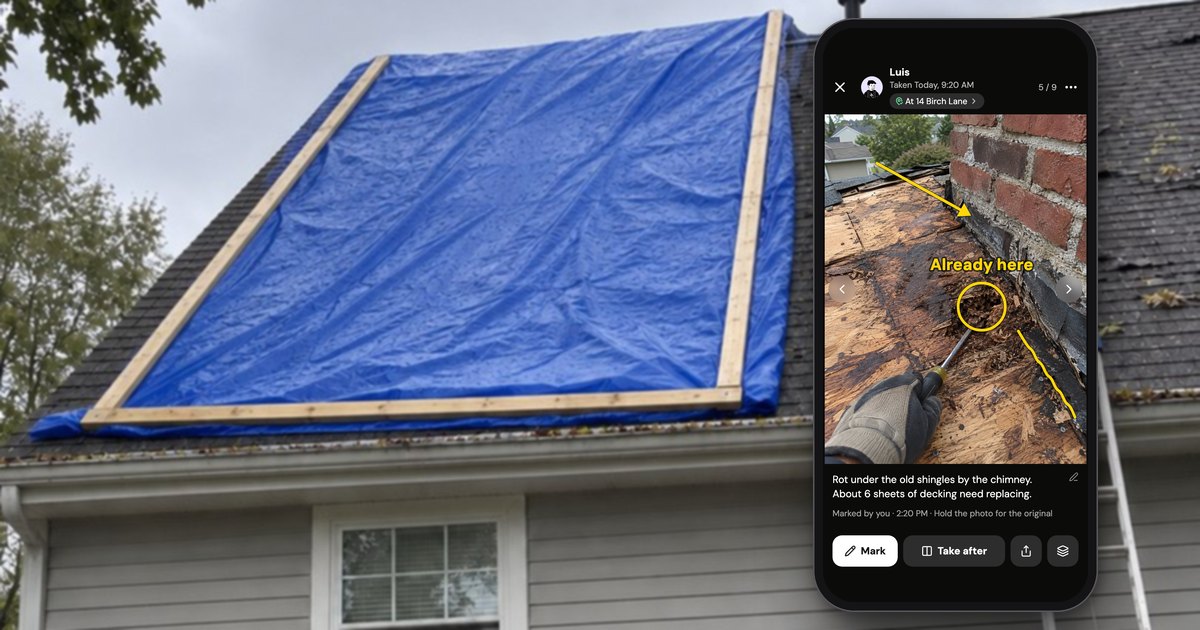
A homeowner can't see their own roof, and the roofing trade tells them not to climb up and look, so a roofer's photos are their only view of the damage. Good photos walk them from the street to the slope to a close-up with a scale, mark the problem in plain words, and arrive the same day with the time on them, so the homeowner can check what they're told.
The app examples below use Handle (usehandle.app), the iPhone and Android app we make for small crews; they're labeled, and where another tool fits better, we say so. Every shot to take, stop by stop, is in the roof inspection photo checklist. This page is about making those photos explain the damage and be believed.
Why can't the homeowner just look at the roof themselves?
A homeowner shouldn't walk a roof to check for damage. In a 2020 release for homeowners hit by Tropical Storm Marco and Hurricane Laura, the National Roofing Contractors Association said homeowners "should only perform a roof system inspection from ground level," because "the risk of falling is too great without the proper safety systems in place" (NRCA, August 2020).
Regulators add a second reason. The Mississippi Insurance Department told storm-hit homeowners: "Allow only the insurance adjuster and roofer you have selected to get up on your roof. Each time someone walks on it, more damage can occur" (press release, March 2013).
Roofers say the same. When a homeowner asked r/Roofing whether it's common for a roofer to tell a potential customer to go up and take the pictures, one roofer answered: "It's definitely unprofessional to ask a customer to go on their roof. I would never do that" (r/Roofing, August 2025). A roofing company's April 2025 review of CompanyCam on Capterra put the consequence plainly: "We do roofing so it's not like people can go outside and watch, it's dangerous."
So the whole conversation runs through your photos, and through what the homeowner has heard about roofers. Another roofer, in a February 2025 App Store review of CompanyCam: "As a roofer it's hard for people to “take my word” on almost anything."
What should you photograph so a homeowner understands the damage?
Photograph roof damage in the order a homeowner would see it if they could climb up: the house from the street, the whole slope with the problem on it, then the damage up close with a tape measure, a ruler or a chalk circle for scale. Add a stretch of sound roof next to it, so they can see what normal looks like.
| The shot | What it tells the homeowner |
|---|---|
| The house from the street, house number in view | "That's my house." Every later photo hangs on this one |
| The slope, wide, from a corner or the ridge | Where on the roof: "the back slope, over the kitchen" |
| The damage up close, with a tape or a chalk circle | What it is and how big |
| The same spot at an angle | Depth: a lifted tab, a crease, a soft spot |
| Sound shingles a few feet away | What normal looks like, so the damage stands out |
| What you found during the work, before you fix it | Why the job or the price changed |
Three or four shots per problem are enough for most homeowners; the full list, gutters to attic, is in the checklist.
The photo that matters most is often one you didn't plan: rot under the old shingles, a second layer nobody quoted, a soft spot by the chimney. Photograph it before you replace anything and send it before you go on: by evening it's under new underlayment. A roofer listed what those mid-job photos did for him in a 2017 Facebook review of CompanyCam: "Sending homeowners pictures of deteriorated plywood, proving unforeseen layers of shingles, and even getting me out of some gutter repairs that we didn't damage."
How do you mark up a roof photo so it explains itself?
Mark a roof photo with one mark per point: a circle on the damage, an arrow to its cause, a box around an area, and a few plain words a homeowner understands, such as "soft decking, about 6 sheets". Mark a close-up, not a wide shot, and keep the unmarked original: the marked copy explains, and the original is the evidence.
A homeowner posted a roofer's photos to r/Roofing with the title "Roofer looked over our roof and provided me with a quote. Can someone make sense of the pictures." "The pointing is ridiculous," one commenter replied: the roofer's app let him "draw circles around supposed damaged areas," but "This would be better with closeups showing exactly what he is pointing at" (r/Roofing, April 2025).
- One point per mark. Three circles on one photo are three photos.
- A bright color. Yellow or red shows on dark shingles; black and blue disappear.
- Write what you see, not a verdict. "Dents, back slope" holds up; "needs full replacement" is the adjuster's call.
- Plain words, not shorthand. A homeowner asked r/Roofing "What did this insurance adjuster mean by this marking?" and could only guess: "FS is likely front slope, but I don't know the pdmg part" (r/Roofing, August 2023). Commenters read it as front slope, prior or possible damage.
| Roofer's shorthand | What to write on the photo |
|---|---|
| FS, RS | Front slope (street side), rear slope |
| Granule loss | The gritty top coat is worn or knocked off; the asphalt underneath shows |
| Failed step flashing | The metal where the roof meets the chimney is loose; water gets behind it |
| Soft decking | The plywood under the shingles is rotten; a screwdriver goes in |
| Nail pops | Nails pushing up through the shingles |
| Hail hits | Dents where hail struck, circled in chalk |
Handle, as an example. Open a photo in Handle and tap Mark. Your finger draws right away, in yellow by default. Arrow, Circle, Box, Words and Colour sit in a row of large, labeled buttons along the bottom, made for a gloved hand on a ladder. Tap one of your marks to move it, resize it, recolor it, copy it or delete it; leaving the editor saves. Words on a mark take up to 80 characters. The camera's post screen has Mark too, so you can mark a photo before you post it.
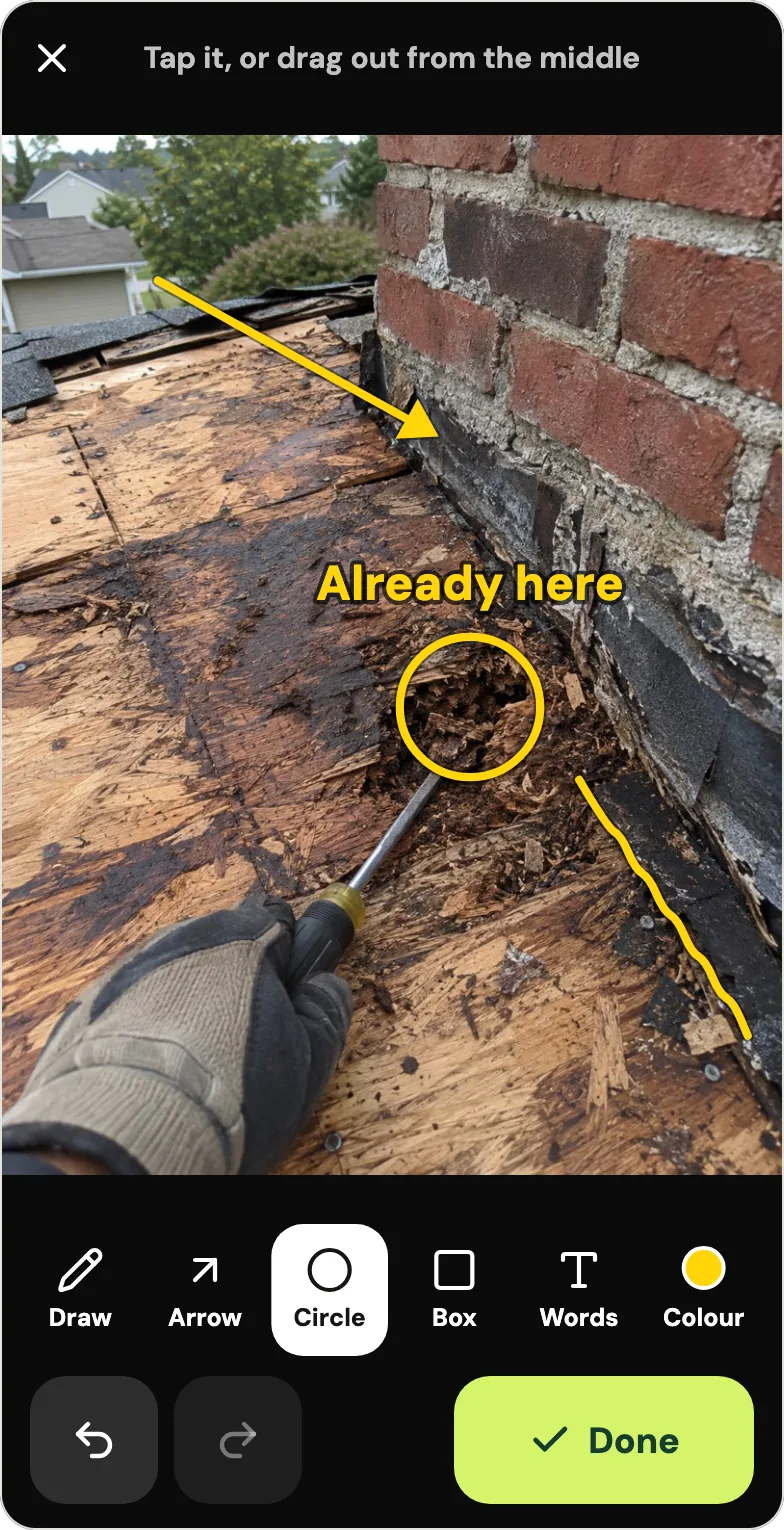
In Handle, marks never change the photo underneath. They are a layer over it, and each person's marks are their own layer: the rest of the crew sees them, but they stay that person's. Under the photo, the viewer says who marked it and when ("Marked by you · 2:20 PM · Hold the photo for the original"), and holding a finger on the photo shows it without the marks. When you send it, a switch leaves the marks off (next section). What leaves Handle is a stamped copy, not the camera's original file: see When Handle is not for you.
How should you send roof damage photos to a homeowner?
Send roof damage photos the same day, from the number the homeowner already has, as a few marked photos in the order they'd walk the roof, each with the time and a line of words on the picture. For a whole inspection or a finished job, send one PDF instead of forty loose texts.
| What you're sending | How to send it |
|---|---|
| A problem found mid-job ("rot by the chimney, about 6 sheets") | A text with one to three photos, before you go on |
| The inspection results | Five to ten photos in walking order, or one PDF |
| The finished job | One PDF: the before, what you fixed, the after |
| Anything for an insurer | Your full set, plus the unedited original files |
Put the words on the picture, not only in the message: a caption typed as a separate text stays behind when the homeowner forwards the photo to a spouse or an adjuster. If the photo changes the price, get the homeowner's OK in a reply before you replace anything, so the photo and the OK sit in one thread.
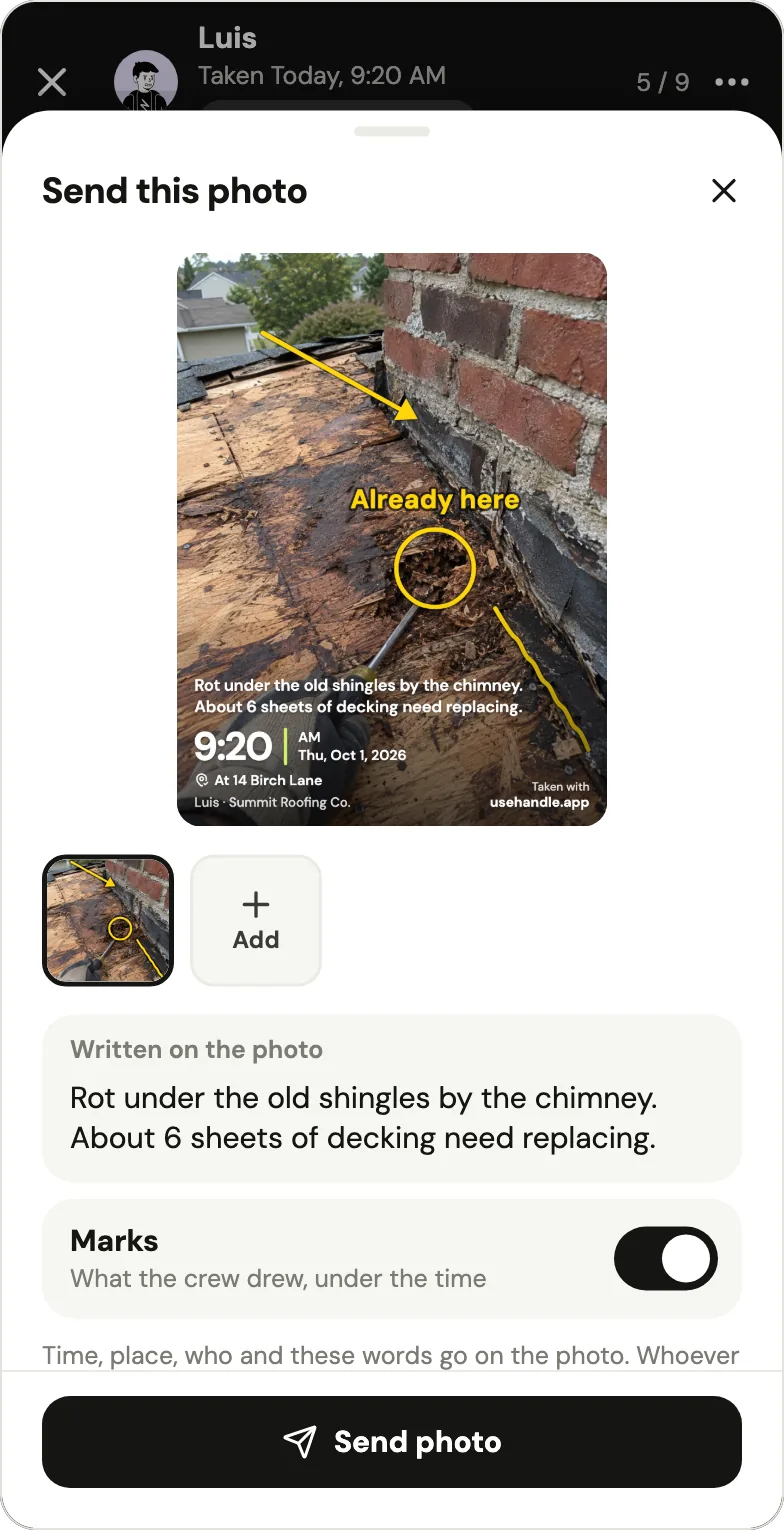
Handle, as an example. Open the photo and tap the share button next to Take after. The Send this photo sheet shows the picture as it will arrive: Handle writes the time and date, who took it and the business on it, the job's address when the phone was at or near the job, and the words you type under Written on the photo. Add puts more of the job's photos in the same send. When a photo has marks, a Marks switch ("What the crew drew, under the time") is on; turn it off to send the clean photo with its stamp. Tap Send photo and pick a text, WhatsApp or email: it goes from your own phone. When the job has a customer with a phone number, the owner's sheet offers Text to and their first name, which starts a text to them with the photo, plus Other apps… (the taps in Handle's help).
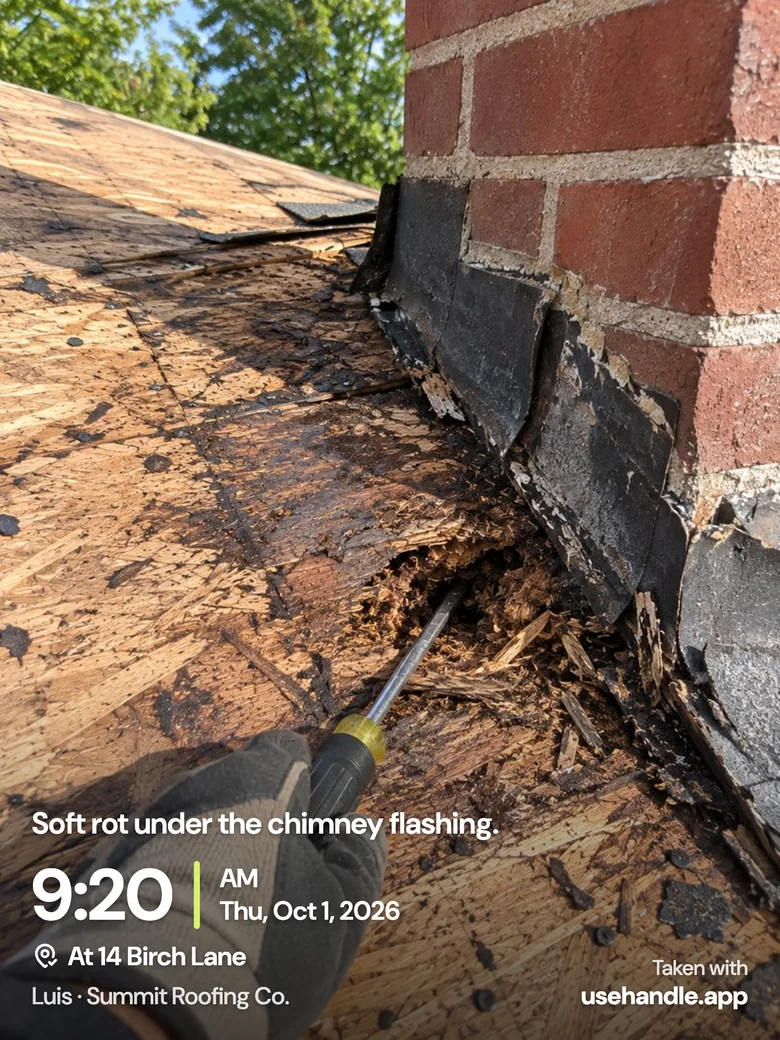
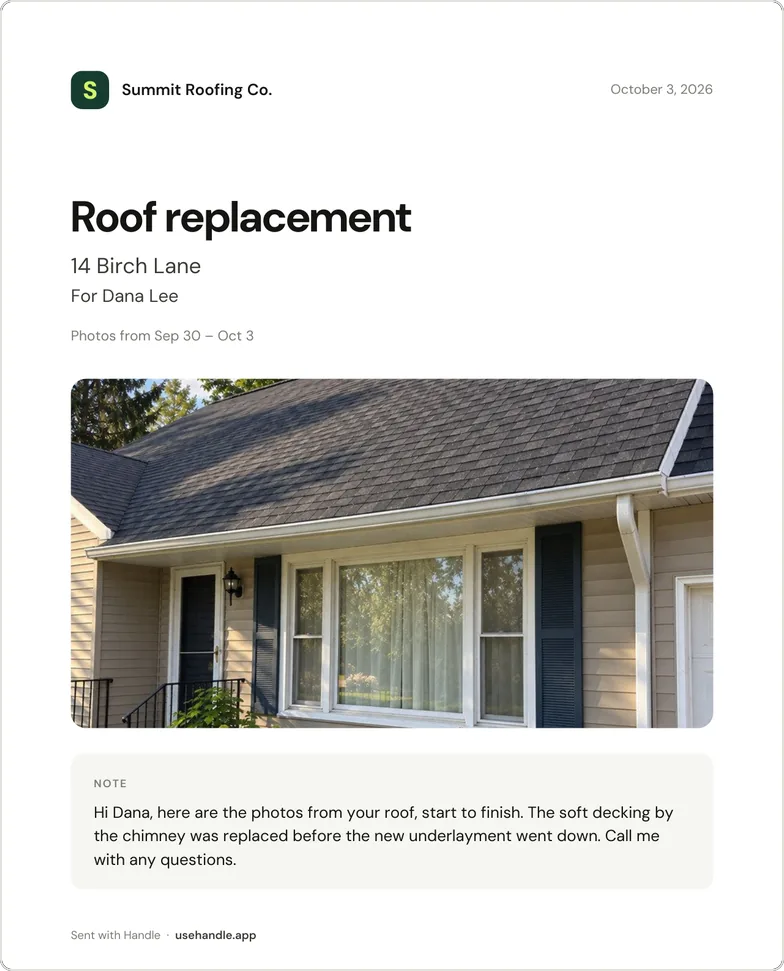
The whole roof as one PDF. For a finished job or a full inspection, the owner can send the whole job as one PDF from the job's share button. The first page carries the business, the job, who it's for, the photos' dates, one large photo and a note you write for the homeowner (it changes only the PDF). Each photo inside is stamped like a sent photo, so a photo cut out of the PDF keeps its time, and its place when it was taken at the job. The PDF shows the photos as they are on the day you make it. The taps are in sending a job as a PDF; how to order a report is in the checklist's report section.
What do insurance adjusters need from your photos?
An insurance adjuster usually looks for more than the problem spot: every slope, damaged or not, the dented soft metals (vents, gutters, flashing), the damage up close with a scale, and the roof before permanent repairs (photograph before and after any emergency tarp). Adjusters take their own photos, but the person who decides the claim may not see all of them, which is why one roofing company's CEO tells contractors to send in their own set the same day.
"They may take 150 photos, but you have no idea which of those get sent to the insurance company," Chad Conley, CEO of Complete Roofing in Woodstock, Georgia, wrote of adjusters in Roofing Contractor (January 2023). With evidence "under collected by the insurance company's on-site representative," he wrote, "it is common for the assigned desk adjuster or claim manager to not see the same thing you did." His advice: what you documented with the adjuster should be sent in, by you or the homeowner, "the same day the inspection occurred."
- Be there. The NRCIA's claim guide tells homeowners: "We strongly recommend having your trusted roofing contractor present during the adjuster's visit" (NRCIA, March 2026). Point out what you found while the adjuster takes their own photos.
- Your set may be the only one the homeowner sees. In a thread titled "Insurance is claiming roof has 5 layers without proof", the homeowner wrote: "They won't even share photos with me regarding the claim" (r/Roofing, April 2024). One commenter there replied: "Typically their work product, such as photos, would not be provided to you" (the reply). That's one person's experience, not a rule.
- Show the cause, not only the damage. "Adjuster says this can't be hail damage" (r/Roofing, August 2024) is an argument about cause. One bad shingle won't make that case; the pattern across the slope, the chalked hits and the dented soft metals give the adjuster something to weigh (they're in the checklist).
What homeowners are told matters too. The Texas Department of Insurance tells them after hail: "Be available for the adjuster visit." It also says: "It's illegal to waive a homeowners deductible under state law" (TDI, updated December 2025). In Florida, a contractor may not offer "a rebate, gift, gift card, cash, coupon, waiver of any insurance deductible, or any other thing of value" in exchange for inspecting a roof or for a homeowner making a roof claim (Florida Statutes 2026, §489.147). Rules vary by state, and this isn't legal advice.
Handle, as an example. Handle's stamp and job PDF are written for a homeowner to read. Handle removes the hidden data inside a photo file (EXIF) before upload, so a photo sent from Handle carries its stamp but not the original file's metadata. If a claim calls for original files, see When Handle is not for you.
How do photos protect you when a homeowner says "you damaged it"?
Photos protect a roofer from a "you damaged it" claim only when they were taken before the work started: the driveway, gutters, AC unit, siding, plants and the ceilings inside, each with the time on it. They help most when the homeowner saw them before you began, and they don't win every argument.
The driveway is the classic. "One of the most common excuses involves the claim that either the roofer or the roofing supplier caused driveway cracks," the law firm Trent Cotney, P.A. wrote for the Florida Roofing & Sheet Metal Contractors Association. The firm's advice: photos "taken prior to any truck being placed on the driveway." Its reason: "The majority of the time, homeowners are complaining of cracks that existed prior to construction" (FRSA, November 2015).
Inside counts too. A homeowner on r/Roofing wrote that during a reroof "the vibrations caused a 2x4 in the attic to puncture a hole in the ceiling" (r/Roofing, June 2026). A commenter replied: "Every roofer I've gotten quotes from has something about possible drywall damage" (the reply). Whether your contract covers that is a question for your attorney; the photos of the ceilings before tear-off are yours to take either way.
When the before exists, it often works. In an r/Roofing thread about photo apps for insurance work, a contractor wrote of the job photo app his company uses (CompanyCam): "it has even saved my butt a couple of times when clients try to claim that our guys have caused accidental damage" (r/Roofing, January 2024).
When the call comes:
- Find the before of that exact spot, with its time, before you answer.
- Send it with one plain line, with no argument in the first message: "Here's your gutter on Sept 30 at 8:10 AM, before we set a ladder."
- If your before doesn't show the spot, say so, and go look at it together.
- If it was you, fix it. The photos that clear you next time are worth more than winning this one.
Photos aren't a guarantee. In 85 posts and comments by business owners on Reddit and a trade forum (2023 to 2026) that Handle collected in September 2026, "you damaged it" or "you didn't do it" came up 24 times, more than any other complaint, and it was where owners reported losing money. Several of those owners had before photos and still refunded. That's one sample across trades, not all roofers.
Handle, as an example. A photo taken in Handle keeps the time it was taken, even when it was shot in a dead spot on a roof and went up later, once there was signal and Handle was open. Mark the damage that was already there, as in the photo above ("Already here"), and the mark goes on the sent photo. On a before-and-after, opening the before and tapping share offers Send just the before, which is the one photo this call needs.
Why do homeowners doubt roof photos, and how do you earn their trust?
Homeowners doubt roof photos because fake ones exist: Connecticut's Better Business Bureau warned in 2022 that some roofers tear off shingles to mimic wind damage, "or they may simply show you pictures of someone else's damaged roof" (NBC Connecticut, April 2022). An honest roofer earns trust by making each photo checkable: the homeowner can tie it to their house, their slope and the storm's date.
The same BBB words ran in BBB Serving Wisconsin's alert in May 2020, and the National Insurance Crime Bureau lists "manufactured roof damage" among post-storm fraud schemes, as cited by Roofing Contractor (May 2026). Two recent cases:
- North Carolina. After door-knocking roofers in Wake County were "reportedly seen damaging roof shingles to make it appear that wind or hail had caused the problem," North Carolina Farm Bureau Insurance and state regulators set up a sting with a "bait house" in Raleigh, and engineers inspected its roof before and after the roofers went to work. Of two brothers caught in it, one was ordered to pay "some $27,678 in restitution" and the other got 24 months' probation (Insurance Journal, September 2026).
- Florida. After a contractor told a resident her roof was severely damaged, "providing 14 photos as evidence," two roofing companies that had evaluated the roof earlier "had their own photos showing none of the damage," Roofing Contractor reported (October 2025). Their earlier photos are what exposed the fake.
Homeowners are told to check. Consumer advocate Shirley Rooker of Call for Action told WJLA viewers to "get binoculars, if you can, and get a line of sight to the area that they say needs work," and then: "Secondly, have them take your phone or a digital camera up there" (WJLA, February 2020). Under the homeowner's r/Roofing post above, a commenter wrote: "We have no way of knowing if he peeled them up himself" (r/Roofing, April 2025).
So give them what they need to check:
| Do this | Why it earns trust |
|---|---|
| Make the first photo the house from the street, number in view | It's their roof, not a stock photo or someone else's |
| Keep a landmark (the chimney, a vent) in both the wide shot and the close-up | The damage sits on a spot they can see from the yard |
| Show damage across the slope, and sound shingles beside it | Hail damage spreads across a slope; damage confined to one spot raises questions |
| Keep the time on every photo, and name the storm's date | They can check the date against public storm reports |
| Offer to take their phone up, or point to what they can see with binoculars | They can check without trusting your camera |
| Welcome a second opinion or the insurer's inspection | It's the BBB's advice too: "Get your insurance company to inspect your roof." (Wisconsin, 2020) |
The pattern row comes from engineers Battaglia and Webb of Donan Engineering: "intentional damage is often confined to an isolated area on the roof," while "hail does not pick and choose shingles" (CLM Magazine, January 2008). For the storm date, the National Weather Service's Storm Prediction Center keeps each day's hail, wind and tornado reports in a public archive by date (spc.noaa.gov), with the note "All Reports Are Considered Preliminary".
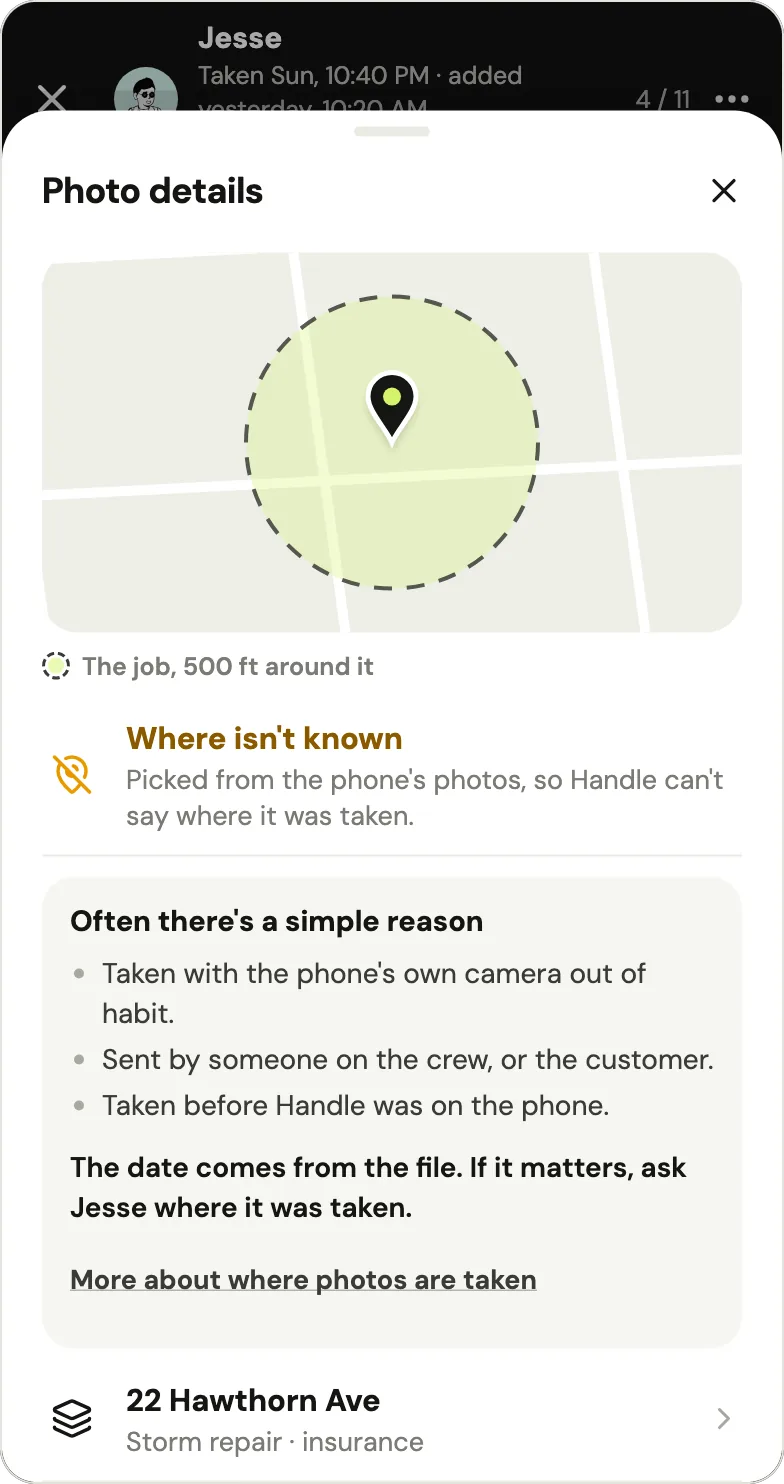
Handle, as an example. Handle's stamp states only what the phone knew (what a sent photo says, case by case). Two rules matter most to a doubting homeowner. The job's address ("At 14 Birch Lane") appears only when Handle's server finds the phone was at or near the job; the phone can't decide that itself. If the phone's location was only approximate or came from a mock-location app, the stamp shows the time only. And a photo picked from the camera roll says "From the phone's photos", never "Taken".
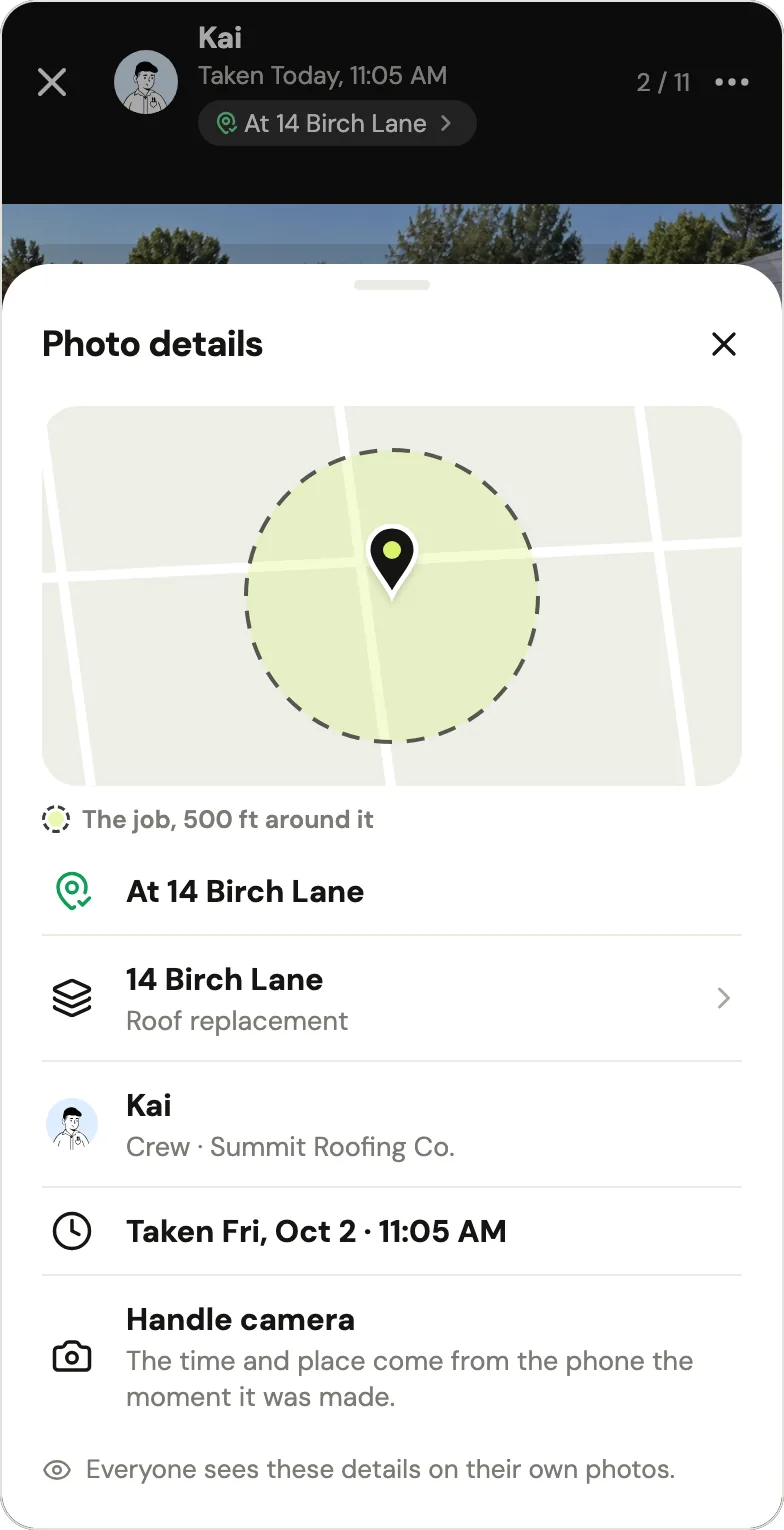
Handle has to know where a job is first (from its street address and a good photo near it, from photos that agree, or from the owner's pin); until it does, nothing is at or near the job, so the stamp shows the time only. Inside the app, the owner and the person who took a photo see where it was taken in Photo details: the job's circle on a map (500 ft around it by default), a dot for where the phone was when its location was precise, who took it and when. Customers never see that map. No app's stamp proves where a photo was taken (what the location lines mean). A stamp that never overstates is one a homeowner can keep trusting.
Is there a free app for a roofing crew to mark up and send damage photos?
Yes. A phone's own photo editor can draw on a picture for free, but the photo stays in one person's camera roll; several job photo apps keep a crew's photos on the job and let anyone mark them up. Handle, our app, is one of them; it stamps each photo you send, and Handle is free for your whole crew: no trial, no card, no per-person fees.
Job photo apps differ in price, in what the sent photo says, and in whether the homeowner gets a link or a picture.
Handle is a free iPhone and Android app for small field crews: it keeps the crew's job photos, notes and voice notes together, job by job, on every phone in the crew. Everything on this page (Mark, Send photo with its stamp, Take after, the job PDF) is included in the free app (what's free). Handle (usehandle.app) is not affiliated with Handle.com or Handle by Texada.
When Handle is not for you
Handle is a crew's job photo app for phones. It doesn't hand over original photo files, give the homeowner a page to follow the job, or replace inspection and measurement software. If you need one of those, use a tool built for it:
- An insurer or adjuster wants the original files with their metadata. A photo sent from Handle carries the stamp but no hidden data: Handle removes EXIF data, including location, from every photo before upload (privacy policy), and there's no export of a job's original files. For claim work, also shoot the damage with your phone's own camera, which keeps the original files in your camera roll, or use a tool built for insurance documentation.
- The homeowner should follow the job on a live link. Handle has no customer link; you send photos and PDFs from your phone. CompanyCam's Timeline "is a live link to the whole Project that updates as you take new photos," and "Your customer doesn't need an account to open a Gallery or a Timeline" (as of October 2026, CompanyCam help).
- A stamp burned in the moment you take the photo. Handle writes its stamp when you send a photo. CompanyCam's optional stamps "add the exact time, date, and location to the corner of every photo you take," and each user turns them on (as of October 2026, CompanyCam help).
- Inspection checklists, branded reports or roof measurements. Handle has none of them; a roofing inspection or measurement app fits better.
- Scheduling, estimates and invoices. Handle doesn't do them; a field service app does, and your photos can sit alongside it.
- An iPad or a computer. Handle runs on iPhone and Android phones; there's no iPad version and no web app.
Questions owners ask
Should homeowners go on the roof to see storm damage themselves?
No. The National Roofing Contractors Association says homeowners "should only perform a roof system inspection from ground level" (NRCA, August 2020), and every walk on a damaged roof can add damage. Look from the yard, with binoculars if you have them, and ask the roofer for photos: the house from the street, the slope, and the damage up close.
How do I show a homeowner hail damage on their roof?
Shoot the slope wide, then the hits up close with chalk circles and a tape measure for scale, then sound shingles and dented soft metals such as vents and gutters, so the pattern shows. Write a few plain words on the photo ("hail dents, back slope") and give the storm's date, which the homeowner can look up in the National Weather Service's public storm reports.
Do insurance adjusters accept a roofer's photos?
Adjusters take their own photos and decide the claim, but your set helps when theirs misses something. Chad Conley, CEO of Complete Roofing, advises sending your own documentation "the same day the inspection occurred" (Roofing Contractor, January 2023). Keep the unedited originals. No set of photos guarantees a claim is approved.
Can a roofer fake roof damage photos?
Yes, it happens. Connecticut's Better Business Bureau warned in 2022 that some roofers tear off shingles to mimic wind damage, "or they may simply show you pictures of someone else's damaged roof" (NBC Connecticut, April 2022). A homeowner can check: the house in the first photo, the same spot in the wide and close shots, the storm's date, a look through binoculars, and a second opinion or the insurer's own inspection.
Should I send homeowners marked-up photos or the originals?
Both, to different people. Send the homeowner the marked photo: a circle and a few plain words explain more than a clean close-up. Keep the unmarked original for the adjuster and your records. In Handle, marks are a layer over the photo, and a Marks switch on the send screen sends a stamped copy with or without them; if an adjuster needs the camera's original file with its metadata, also shoot with your phone's own camera.
Is there a free app for roofers to mark up and send stamped photos?
Yes. Handle, on iPhone and Android, is free for your whole crew: no trial, no card, no per-person fees. The crew marks photos on the job, and you send a photo with the time, who took it and your words written on it, or the owner sends the whole job as one PDF (what's free).
Every photo, on the right job.
Handle is free for your whole crew: no trial, no card, no per-person fees. On iPhone and Android.