Pre-existing damage in car detailing: the intake walkaround, the waiver and "you scratched it"
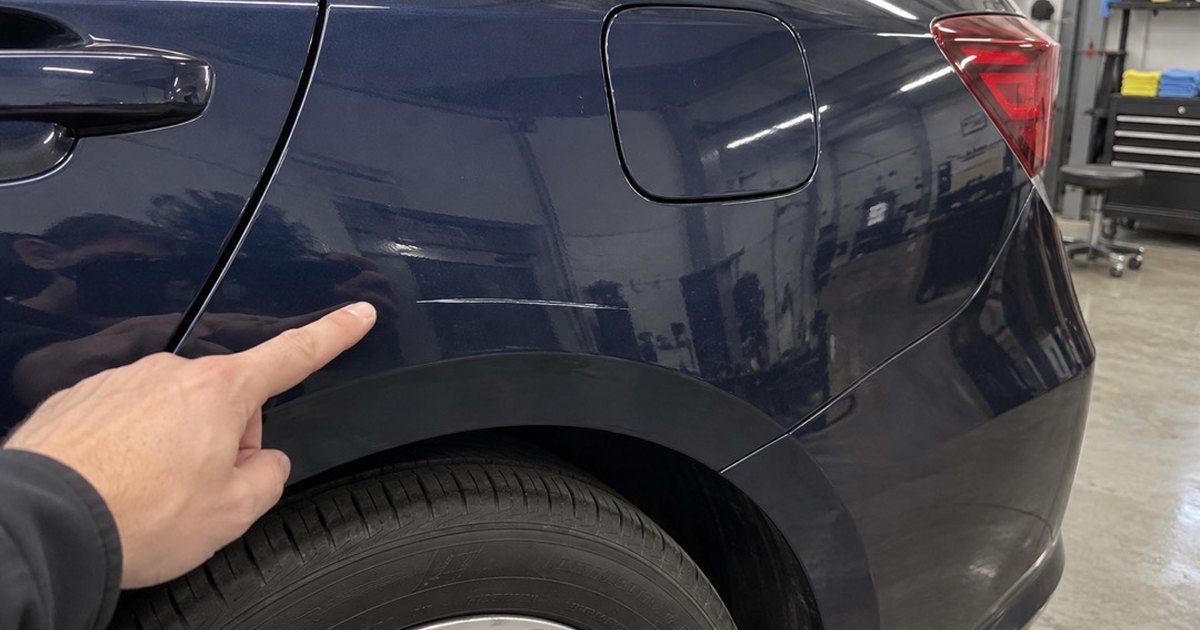
Before you touch a customer's car, walk around it with them in good light, photograph it the same way every time (the four corners, each panel at an angle, wheels, glass, the interior and the dash with the engine running), mark every existing defect with a few words, and get the customer's OK in writing. Then look again after the wash, because clean paint shows what the dirt hid.
The app examples use Handle (usehandle.app), the iPhone and Android app we make for small crews; they're labeled, and where another tool fits better, we say so. Matching before and after shots (angles, light, the after from the same bay) are in our before and after photo guide; this page covers the intake, the waiver and the dispute.
Why do detailers get blamed for damage that was already there?
Detailers get blamed for old damage because dirt, wax and dim light hide defects at drop-off, cleaning and correction reveal them, and the customer sees them the next day in daylight. A defect nobody photographed at intake looks like something the detailer did.
Detailing makes old damage visible. An Australian guide to detailing agreements puts it plainly: "Detailing can also reveal existing issues because dirt, wax, silicone dressings or poor lighting were hiding them" (Sprintlaw, October 13, 2026). A reply to a car owner who saw new white marks after a correction and ceramic coating: "Your paint is now more glossy, which makes all imperfections a lot more visible, including rock chips. We're all guessing here as you're posting an after photo, and not before" (r/Detailing, August 2026).
For some shops it's routine. One detailer: "At least 2-3 times a month I get a customer trying to blame me for dents, scratches, even a cracked windshield one time. I always just take pictures of damaged vehicles when they show up to prevent any BS" (r/AutoDetailing, May 2026). That's one shop, not a rate. Across trades it's the same story: of 85 owner comments from Reddit and trade forums (2023 to 2026) that Handle's team tagged in September 2026, 24 fell under one tag, "you damaged it / you didn't do it", the most common complaint in that sample. The count describes that sample, not detailing as a whole.
Customers now bring their own before photos. A detailing company's guide for car owners tells them to walk around the car "in good lighting, ideally during daylight hours" and to photograph it "in natural light and from different distances so the damage is clearly visible" before the appointment (CDC Auto Detailing, February 2026). In 2026 threads on r/Detailing, customers did exactly that: "Right before the service, I took photos of my entire car inside and out" (April 2026), and "I also took a full 360 video of the car outside their shop before leaving it with them" (September 2026). Your intake set has to be at least as complete, as close and as well lit as theirs, or theirs is the only record.
What should the intake walkaround photograph?
The intake walkaround should photograph the whole car from its four corners, each panel along the paint, every chip, scratch and dent up close with something for scale, all four wheels, the glass and lights, the interior, the dash with the engine running, and whatever is left in the car. Take them in the same order every time, so nothing gets skipped.
| Shot | How | What it answers later |
|---|---|---|
| Four corners, wide | Whole car in frame, plate visible in at least one | "Is that even my car, that day?" |
| Each panel along the paint | Low, with the light raking across; no flash | Swirls, scratches and failing clear coat that only show at an angle |
| Every chip, scratch and dent | Straight on, then at the angle that shows it, with a fingertip or coin for scale | "That scratch is bigger now" |
| Wheels and tires, all four | Each wheel face, close | Curb rash and marked rims blamed on the wash |
| Glass and lights | Windshield, headlights, mirrors | Chips, cracks, haze, a cracked windshield |
| Trim, badges, seals, rockers, roof | Close, both sides | Loose trim, chipped rockers, roof damage nobody looked at |
| Seats, carpet, headliner, door panels | Each seat; stains, burns, tears close | "That stain is new", "you tore it" |
| Screens | Off, from straight on, without glare | Scratches and old marks on the display |
| The dash, engine running | Warning lights once the start-up check clears, and the odometer | Warning lights blamed on the detail |
| Trunk, personal items, aftermarket parts | What's there, as you found it | "Something's missing", "you broke my phone mount" |
The list matches what an Australian legal guide says a condition record should hold: Sprintlaw names "Existing scratches, dents, chips, rust, peeling clear coat and paint defects", "Cracked lights, mirrors, trims, badges, seals and plastics", "Interior stains, burns, tears, odours, mould, pet hair and excessive debris" and "Loose items, aftermarket accessories, dash cams, phone mounts and child seats" (Sprintlaw, October 2026; Australian law, but the car is the same).
The dash shot is easy to skip and cheap to take. Electrical faults that show up after a detail get blamed on it: one customer's seat-belt sensor "won't stop beeping" and the seat heater "wont turn on" (r/Detailing, March 2026). A mobile detailer whose customer's Subaru battery died and trunk wouldn't latch during an interior detail: "from experience i know which cars have problems that are not at your fault but customers try to make it seem like it's your fault" (r/Detailing, April 2026). A photo of the cluster at drop-off, with the engine running (with only the key on, most cars light every warning lamp as a bulb check), settles one question either way: which warning lights were already on. It won't show whether a seat heater works; test that, or note it, if the customer cares.
Not every car needs all of it. A quick wash on a work truck doesn't; a correction, a coating, an expensive car or a first-time customer does.
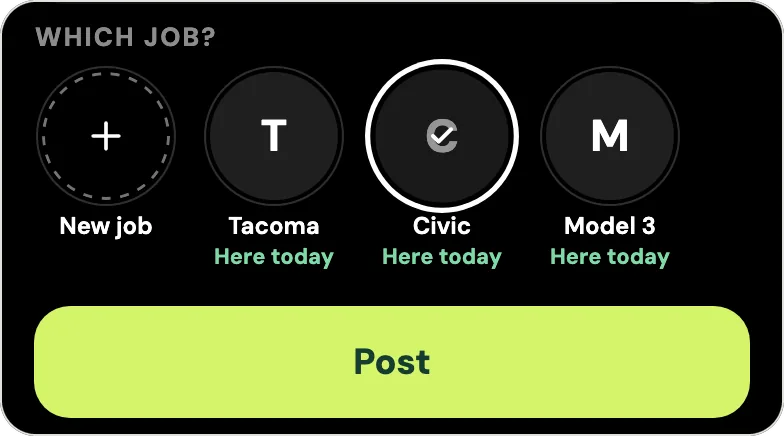
Handle, as an example. In Handle, a detailing crew names each job by the car ("Honda Accord · Navy") and what's being done ("Full detail"). Shoot the intake from the car's job, and every photo lands on that car. If you shoot from Home, Handle picks a job by itself only when it's sure, and it never picks one by location at the business's usual place: in a shop with three cars under one roof, it asks Which job? after the photos, with the cars someone worked on there today marked Here today (how photos land on the right job). One tap picks the car.
How do you photograph damage so the photo can't be argued?
To photograph damage so it can't be argued, shoot each defect twice (straight on, then at the angle the light shows it), put something in the frame for scale, skip the flash on gloss, and take a wide shot of the same panel so the close-up can be placed. Shoot in good light and keep the originals.
- Angle. A shop owner who went back to paper forms explained the problem with photos alone: "You also won't get in a situation where a customer says a scratch is bigger than before, and their picture is from a more dramatic angle than yours" (r/AutoDetailing, May 2026). Take your own dramatic angle first, and you've already shown it.
- Glare. A coating installer, on a customer's before photo of a screen: "The 'before' shot of the screen shows so little because glare at a hard angle" (r/Detailing, April 2026). Step to the side until the reflection leaves the defect.
- Light. In the soft-top case below, the customer inspected the car "in the dark" (r/AutoDetailing, April 2026). A commenter who details on the side: "Just a few minutes with bright lighting could have avoided all of this" (r/AutoDetailing, April 2026). Mike Phillips makes the same point about fluorescent shop light versus sunshine in his guide to vehicle inspection forms (Autogeek forum, December 2019).
- Scale. A fingertip, a coin or a tape measure next to a chip turns "small" and "huge" into a size.
- Originals. Keep them unfiltered and uncropped. A brightened photo invites "you edited it".
Handle, as an example. Each photo in Handle shows who took it and when ("Taken Today, 9:41 AM"), and its details say "The time and place come from the phone the moment it was made." In a garage with no signal, Handle saves the photo on the phone first and it goes up once there's signal and Handle is open, keeping the time it was taken (no signal).
How do you mark existing damage and get the customer's OK?
To get a customer's OK on existing damage, walk the car together, point at each defect, mark it on the photo with a few words, and get agreement in writing before you start: a signature on your inspection form, or a reply to a text with the marked photos. If the customer isn't there, photograph everything and call before the first touch.
Mike Phillips's advice on the Autogeek forum is the core of it: "always inspect a customer's car with the customer while he's at your shop", "mark them down on your VIF" (vehicle inspection form), and "POINT THEM OUT TO THE OWNER" (Autogeek forum, December 2019). Detail King's walkaround guide adds the drop-and-go customer: photograph the damage with your phone, then call (Detail King, updated June 2021).
Photos and paper work together. The paper-form shop owner: "You have a signed form that says there was a scratch there," and "online/on-screen signatures can really confuse a lot of customers" (r/AutoDetailing, May 2026). A text works too: send the marked photos with "These were on the car at drop-off. Dirt can hide more, so we'll look again after the wash and call before polishing anything new. OK to start?" and wait for the reply. Either way, the customer has seen each defect before you touched the car.
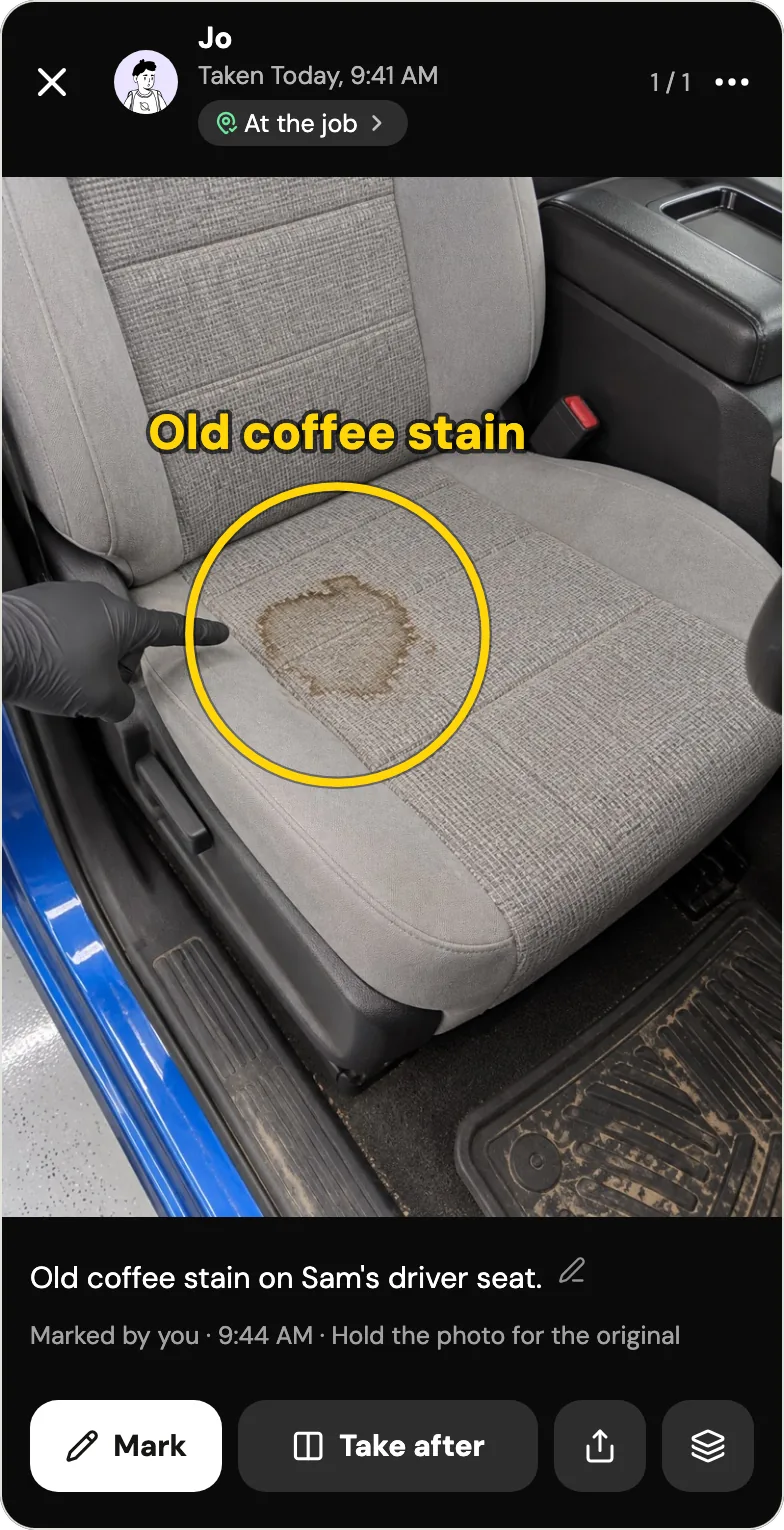
Whatever you mark with, write the words, not only a circle. Square, a card processor, says the copy a customer's bank reviews in a dispute "is in black and white" (Square support, October 2026). In our own test (October 2026), we turned the marked seat photo below to grayscale: the outlined words stayed readable while the yellow circle faded to pale gray. On white or silver paint, pick red or black.
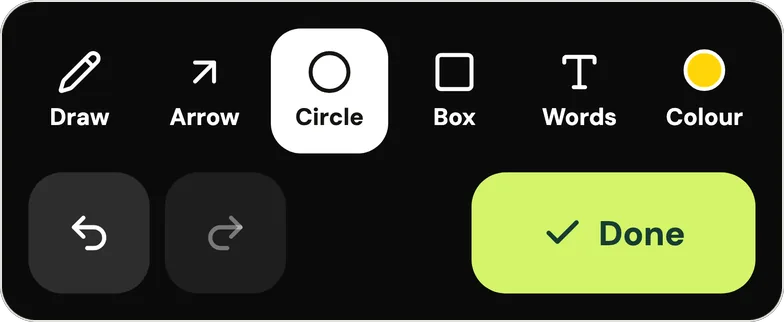
Handle, as an example. Open the photo, tap Mark, and circle, box or arrow the defect, then tap Words to write on it (up to 80 characters), in yellow, red, white, blue or black. The photo itself never changes: marks are a layer over it, the detailer sees "Marked by you · 9:44 AM · Hold the photo for the original", and everyone else on the crew sees the same marks with the name of who marked it. Under the photo, the word box suggests "Say what happened… “scratch was already there”", and only the person who posted a photo can change its words (words, notes and voice notes). Send photo then sends it from your own phone, by text, WhatsApp or email, with the time, who took it, the business and your words written on it; a Marks switch, on unless you turn it off, decides whether the marks go on the sent copy (send a photo). Handle has no customer link, and no signatures or forms: the customer's "OK" is their reply in your messages, so keep the thread.
What should a pre-existing damage waiver say?
A pre-existing damage waiver for car detailing should say that the defects recorded at intake were there before the work, that cleaning and correction can reveal or worsen existing defects, who carries the risk of a method the customer insists on, and how and when to report a problem. Get it signed, or agreed in writing, before the first touch. A waiver may not cover damage from your own carelessness, and sometimes the safer answer is to refuse the method; this isn't legal advice.
Shops that have been burned write it into their terms. A former shop owner on how he'd have answered a customer's claim: "I would have immediately pointed out the damage in the photos and then pointed you to the part of our satisfaction guarantee that states prior damage can be revealed to be worse than initially expected and any further damage to that area by our cleaning process is not our fault" (r/Detailing, April 2026). Another: "most reputable shops also have it in their package info that prior damage can be an issue" (same thread).
The hard case shows why the risky-method line matters. In an April 2026 post on r/AutoDetailing, a 20-year-old mobile detailer in Austin wrote that a customer "explicitly requested" he power wash the soft top of her 2012 Fiat 500C. He stopped when he saw abrasion and told her; she "inspected it in the dark, paid $225, and tipped." The next morning, in daylight, she wanted the top replaced: "One independent shop quoted $7,000+." His questions to the forum, "Does her explicit request reduce my liability?" and "Does payment and tip after disclosure of damage constitute implied acceptance?", are ones no forum can answer for his state. A plain no to the power washer was the only sure way out; a written warning the customer signed before the job would at least have put her request on paper. Another reply was shorter: "Don't run a business without insurance" (same thread).
You find damage halfway through: what now?
When a detailer finds damage halfway through a job, stop, photograph it, and call the customer before going on. Build that moment into every job: a second look after the wash and decontamination, before any polishing, catches what the dirt hid while it can still be shown as found.
Detail King's guide says the same about damage found mid-job: "Call the customer right away to let them know" (Detail King, updated June 2021). A call before you polish over a defect costs five minutes. A call after the customer finds it costs the argument.
- Second pass: every panel again, in the same light, after the wash, clay and iron remover, and before any compound touches the paint.
- Photograph it as found, with words: "Found after the wash: clear coat failing on the roof, left side."
- Call, then text the photo, and get the OK before you correct over it, or tape it off and leave it, especially when the fix changes the price. Extra work without an agreed price tends to go unpaid. One detailer did a stain the customer wouldn't pay a $40 add-on for: "Got 200 and nothing for the extra stain care" (r/Detailing, July 2024).
Handle, as an example. Post the photo to the car's job with your words; it sits there with the intake photos for everyone on the crew, and Send photo sends it to the customer from your phone with the time and who took it written on it.
"You scratched my car": what do you do?
When a customer says a detailer scratched their car, ask where and for their photo, pull your intake photos of that panel, and compare them at the same angle and light, ideally together in daylight. If your intake shows it, show them; if it isn't on your intake, tell them the same day what you see, and call your insurer before you admit fault or promise a repair. Move the conversation from text to a call.
- Stay calm and ask which panel, and for their photo. A text that does both: "Can you send me a photo of the spot? I'd like to look at it with you today."
- Pull your intake photos of that panel, the wide shot and the close-up.
- Compare at the same angle and light. Their photo may help you: a commenter reading one customer's before photos found "everywhere theres damage on the screen theres marks in the same spot before" (r/Detailing, April 2026).
- If it's on your intake, show them the photo with its time, and the OK they gave.
- If it isn't on your intake, don't hide it. Tell the customer what you see and that you're looking into it, and call your insurer before you admit fault or agree to pay: policies can have rules about both (this isn't legal or insurance advice). If you know the crew caused it, say so early; a detailer at one shop: "if we do accidentally damage something I can guarantee you that the very next thing that we do is pick up the phone and take some accountability for it by telling the customer" (r/Detailing, April 2026).
- Don't flat-deny by text. The coating installer quoted above: "Flat denying any fault is crazy. It's even worse doing it in text," and "this should always shift to a call" (r/Detailing, April 2026).
A card dispute and a repair claim are two different fights. A chargeback is about the price of the detail; a repaint is a matter for your insurer or small claims court. If it becomes a card dispute, answer inside the window: Square gives sellers "a short seven-day window", and Stripe says "usually 7 to 21 days, depending on the card network", with one chance to submit and no links or audio or video files (Square, Stripe, both October 2026). Visa's merchant guide files services that "were poorly performed or did not match the agreed scope" under condition 13.3 and warns that "Statements like 'the item is as described' are not sufficient without documentation" (Visa, pp. 61–62, October 2026): send the dated intake photos of that panel, the customer's OK, and the thread. For small claims, check your own court's rules and print your photos; in California, for example, San Mateo's Superior Court says "Generally, you should have at least 3 copies of all evidence you intend to present at trial" (San Mateo Superior Court, opened October 2026). This isn't legal, financial or insurance advice. The two kinds of card dispute, "not done" and "done badly", are worked through step by step for house cleaners in how a cleaning business proves the job was done; the same rules apply to a detail.
Handle, as an example. The car's job has the intake photos, with who took each and when, and the marks labeled with who made them. Send the stamped photo of that panel from your phone: it names the car's job when the phone was at it, and shows the time only otherwise. The owner can send the whole job as one PDF, "For Dana", with Text to Dana when the job has her number. It's a file frozen on the day it's made; Handle shrinks the photos to aim for under 10 MB, and × takes photos out until it fits a processor's limit (send the whole job).
Do you need garagekeepers insurance?
A detailer who keeps customers' cars in their care usually needs garagekeepers coverage: general liability policies typically exclude property in your "care, custody, or control", including the cars you work on, and garagekeepers covers a customer's car while you have it, within the policy's terms and exclusions. Ask a local agent which form fits and what it excludes; this isn't insurance advice.
TechInsurance's page on insurance for car detailers and washes puts it this way: "General liability insurance excludes coverage for items in your care, custody, or control—including your customers' vehicles," and garage keepers "also covers accidental dents or scratches that happen during a car wash or detailing" (TechInsurance, opened October 2026). Insureon's guide to garagekeepers coverage (Insureon, updated May 22, 2024) describes three forms:
| Form | What it pays (Insureon's words) |
|---|---|
| Legal liability | "pays for a claim if you're found legally responsible for a loss" |
| Direct primary | "automatically covers a loss, regardless of who is at fault" |
| Direct excess | "covers losses after the customer's personal auto insurance reaches its limit" |
For a sense of cost, one mobile detailer: "I have a modified garage keeper policy since I'm mobile. Paying around $1200 a year" (r/Detailing, August 2026). That's one owner's policy, not a quote. Your intake photos support a claim; they don't replace the coverage.
Paper form, detailing software or a job photo app?
A paper inspection form and a phone camera cost almost nothing and get a signature. Detailing shop software adds booking, invoices, inspections and on-screen signatures for a monthly fee. A job photo app puts every crew member's marked intake photos on the car's job, free, without signatures. Some shops use two: software or paper for the signature, photos for the detail.
| Paper form and phone camera | Detailing shop software (example: Urable) | Job photo app (example: Handle) | |
|---|---|---|---|
| Customer's signature | On paper | "Capture customer signatures for payments and approvals", all plans | No |
| Inspection photos | In each person's camera roll | "Capture/Upload HD inspection photos", all plans | On the car's job, from every phone, with who and when |
| Marks and words on the photo | The phone's photo editor can draw on it; the marked copy stays in that person's camera roll | Not mentioned on its pricing or home page | Circle, arrow, box, draw, words, five colors, as a layer over the original |
| Booking and invoices | No | Yes ("Text and email invoicing" on Express) | No |
| Cost for a crew of 1, 3 or 5 | Forms and your phone | Same for any crew size ("Unlimited users"): $70, $120 or $220 a month | Free for your whole crew: no trial, no card, no per-person fees |
Urable facts as of October 2026, from urable.com/pricing: the monthly prices are Express, Pro and Enterprise billed monthly; billed yearly, the same plans are $840, $1,320 or $2,200 a year (the page shows those as $70, $110 and $183 a month). Urable pitches its inspections the same way this page does: "Protect yourself and your business by documenting any damage before you begin work" (urable.com).
Handle, as an example. Handle is a free iPhone and Android app for small field crews: it keeps the crew's job photos, notes and voice notes together, job by job, on every phone in the crew. Handle's own setup describes the detailing trade as "Intake photos, paint, interiors". Handle (usehandle.app) is not Handle.com or Handle by Texada. More on Handle for detailers; comparing photo apps, see Handle and CompanyCam.
When Handle is not for you
Handle, our app, is not for you if you need the customer to sign the inspection or waiver on a screen, booking and invoices, a vehicle damage diagram or VIN scanning, an iPad at the counter, or a page the customer opens (Handle has no customer link). Handle keeps a detailing crew's intake photos, marks and notes on the car's job; it doesn't run the shop. What fits better for each, and when a phone alone is enough:
- The customer to sign the inspection or the waiver on a screen. Handle has no signatures or forms. Urable lists customer signatures on all plans (as of October 2026, urable.com/pricing), or use a paper form.
- Booking, scheduling, invoices or payments. Handle doesn't do them. Shop software such as Urable does, and Handle can sit alongside it for the photos.
- A vehicle diagram to tap damage onto, or VIN scanning. Handle has neither. Urable lists "Scan VINs into vehicle profiles" on all plans (as of October 2026, urable.com/pricing); for a damage diagram, look for a vehicle inspection app.
- An iPad at the counter. Handle runs on iPhone and Android phones; there's no iPad version.
- A customer page or link. Handle has no customer link; you send photos and the PDF from your own phone.
- One detailer, a few cars a week. Your phone's camera and a text to the customer are enough.
Questions owners ask
If a customer pays and tips after I tell them about damage, did they accept it?
Don't count on it. In an April 2026 r/AutoDetailing post, a mobile detailer told a customer about damage to a soft top, she inspected it in the dark, paid and tipped, then saw it in daylight the next morning and wanted a $7,000 replacement top. Whether payment means acceptance is a legal question for your state, and this isn't legal advice. Get the customer's OK in writing before risky work, and have them inspect in good light.
Do I need insurance to detail cars professionally?
Most detailers do. TechInsurance says general liability "excludes coverage for items in your care, custody, or control—including your customers' vehicles", and that garage keepers coverage "also covers accidental dents or scratches that happen during a car wash or detailing" (TechInsurance, October 2026). Ask a local agent which form fits a shop or a mobile business. This isn't insurance advice.
What should a car detailing inspection form include?
The customer's name and the car (make, model, color, plate), the date and the odometer, every existing defect by panel (scratches, dents, chips, curb rash, cracked glass, interior stains, burns and tears), warning lights on the dash, personal items and aftermarket parts left in the car, the photos that go with it, and the customer's signature or written OK.
The customer has their own before photos. Does that hurt me?
Not if yours are better. More customers photograph their car before a detail, and their own photos can show the damage was already there. In one 2026 thread, a commenter read it in the customer's before shots: "The location of that damage is right there in their own before images, just dirty and smudged" (r/Detailing, April 2026). Your intake set should be at least as complete, as close and as well lit as theirs.
Why do rock chips show up after a paint correction?
Usually because they were there and the paint now shines. A reply to a car owner on r/Detailing in August 2026: "Your paint is now more glossy, which makes all imperfections a lot more visible, including rock chips" (r/Detailing). Look again after the wash and before polishing, photograph what the dirt hid, and tell the customer before you correct over it.
Is there a free app to mark up intake photos of damage?
Your phone's own photo editor can circle damage and add text, but the marked copy stays in that person's camera roll. A job photo app keeps the crew's marked photos on the car's job. Handle, for example, is free for your whole crew on iPhone and Android: no trial, no card, no per-person fees. You circle the damage and write a few words on the photo, the original stays underneath, and you send it to the customer from your own phone. Handle has no signatures or forms; shop software such as Urable lists customer signatures on all its plans (urable.com/pricing, October 2026).
Every photo, on the right job.
Handle is free for your whole crew: no trial, no card, no per-person fees. On iPhone and Android.