How a cleaning business proves the job was done: photos, policies and disputes
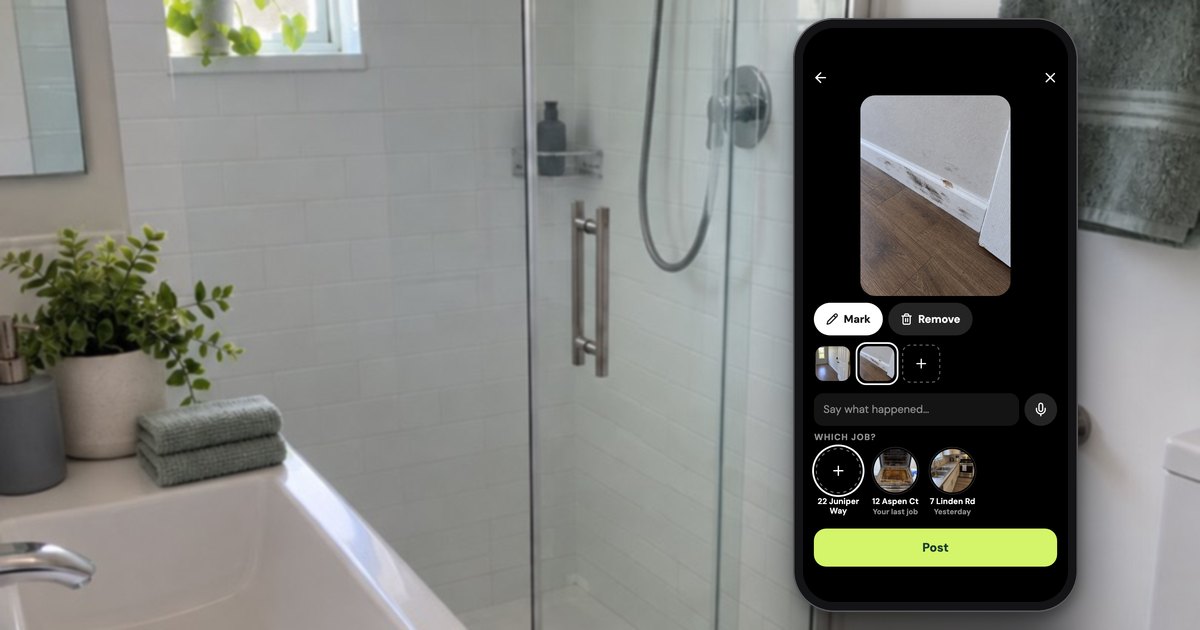
A cleaning business proves the job was done with three records it can show later: the list of what the client booked, photos of the finished rooms taken before the crew left with the time on each, and a written thread of what was said and offered afterward. Many "you missed a spot" arguments turn on the list, not the photo, so put the list and your re-clean and damage policies in writing before the first clean.
The app examples use Handle (usehandle.app), the iPhone and Android app we make for small crews; they're labeled, and where another tool fits better, we say so. Which rooms and angles to shoot is in our before and after photo guide.
What counts as proof that a cleaning job was done?
Proof that a cleaning job was done is whatever answers the client's actual claim. The booked scope answers "you missed the baseboards", dated after photos answer "you never cleaned the bathroom", a photo taken on arrival answers "you broke it", and a re-clean offered in writing answers "it's not clean enough". No single photo answers all four.
| The client says | What answers it | What doesn't |
|---|---|---|
| "You never came" or "the bathroom wasn't cleaned" | After photos of each room with the time on them; the appointment confirmation | A booking in your calendar alone |
| "You missed the baseboards" | The scope list the client was sent, then your after photo of that spot | "We always do baseboards" |
| "It's not clean enough" | The scope, your re-clean offer in writing, a photo of the re-clean | More photos of the same room |
| "You broke the vase" | A photo of it taken on arrival, with a word, before anyone touched it | A photo taken after the client complained |
| A card chargeback | One short file: the scope as the client saw it, dated after photos, the thread, your offer | A link to an online album |
Visa draws the same line, treating a clean that never happened and a poor or off-scope clean as two different disputes (see the chargeback section below).
What should be in writing before the first clean?
Before the first clean, a cleaning business should send the client four things in writing: the scope list for the service they booked (what's in and what isn't), how fast to report a problem and what a re-clean covers, what happens if something breaks, and how keys and codes are kept. Send them with the booking confirmation.
Homeowners are told to ask for the first one. ISSA Residential, the residential cleaning group of the trade association ISSA, advises them: "Ask for a list of what they perform, or request a list of what they will do in your home when the quote is given" (ISSA Residential FAQ, December 2025).
How the scope list settles "you missed a spot"
In September 2026, a customer posted a complaint about a $400 deep clean on r/cleaningbusiness, with the quote they'd been sent and their own photos (the post). One cleaner went through the complaint line by line against that quote, in two replies (shower head and baseboards, objects not moved):
| The complaint | In the quote? | Owed a re-clean? |
|---|---|---|
| Hard water deposits on the shower head and faucets | No | No: "that one's on you" |
| Baseboards | Yes, "Detailed baseboards" | Yes: "they should have to come back for those" |
| Dust under objects that weren't moved | No | No: "Many cleaners refuse to move objects at all due to liability" |
Read that way, the quote answered all three questions; the photos only showed where to look. A list that does this names what's out as clearly as what's in: for each service (standard, deep, move-out), the tasks included, then a "not included unless booked" line.
The re-clean window, and why it's short
ISSA Residential tells homeowners: "If you are unhappy or something was missed call immediately do not wait a day or two when the house will be 'lived in'" (ISSA, December 2025). After a day of cooking, kids and a dog, nobody can tell a missed spot from a new one, so real policies keep the window short:
- One owner: "please notify us within 24 hours. We will return to address any issues at no extra cost to ensure your satisfaction. No refunds will be issued." (r/cleaningbusiness, July 2026)
- Queen of Maids asks clients to report "within two (2) business days", to "take a few photographs of the missed or incomplete tasks", and says a re-clean can't "include any requests that were not a part of the original cleaning agreement" (Queen of Maids service guarantee, opened October 2026).
Breakage, insurance and keys
ISSA Residential covers all three: "Do not wait until it happens; discuss breakage up front"; bonding is "a false sense of security", so ask about liability insurance instead; and on keys, "Ensure nothing that could identify you or your address is on the tag" (ISSA, December 2025). The Cleaning Business Life podcast's notes for its damage episode add the timing: "The best time to write your damage policy is on a calm day, not while you're staring at a $4,500 replacement request" (episode 223, August 2026).
Handle, as an example: none of this lives in Handle. Handle has no checklists, forms or booking, so the scope and the policies go in your booking confirmation or your terms.
What should a cleaner photograph on every visit, and when?
For disputes, a cleaner needs two sets of photos on every visit: on arrival, anything already broken, stained or scratched, with a few words; before leaving, the rooms and items this client checks.
- On arrival, before anything is moved: chipped tile, scuffed baseboards, a cracked lamp, a carpet stain, an old repair on an antique. Add the words while you're standing there: "Scuffs on the hall baseboard were there when we got in."
- Before you leave: the rooms this client checks first (ask at the first clean), from the doorway and close up, plus whatever is easy to doubt. A cleaner who photographed for an employer: "not just a picture of the clean toilet bowl, but a picture of each side underneath" (r/cleaningbusiness, May 2026).
- Anything you couldn't do, with the reason: a locked room, hard water that won't lift, a pet in the way.
On a recurring visit with no history, new damage and the one or two rooms the client checks are enough. Shoot every room on a first, deep or move-out clean (inside the appliances on a move-out) and for a client who has complained before.
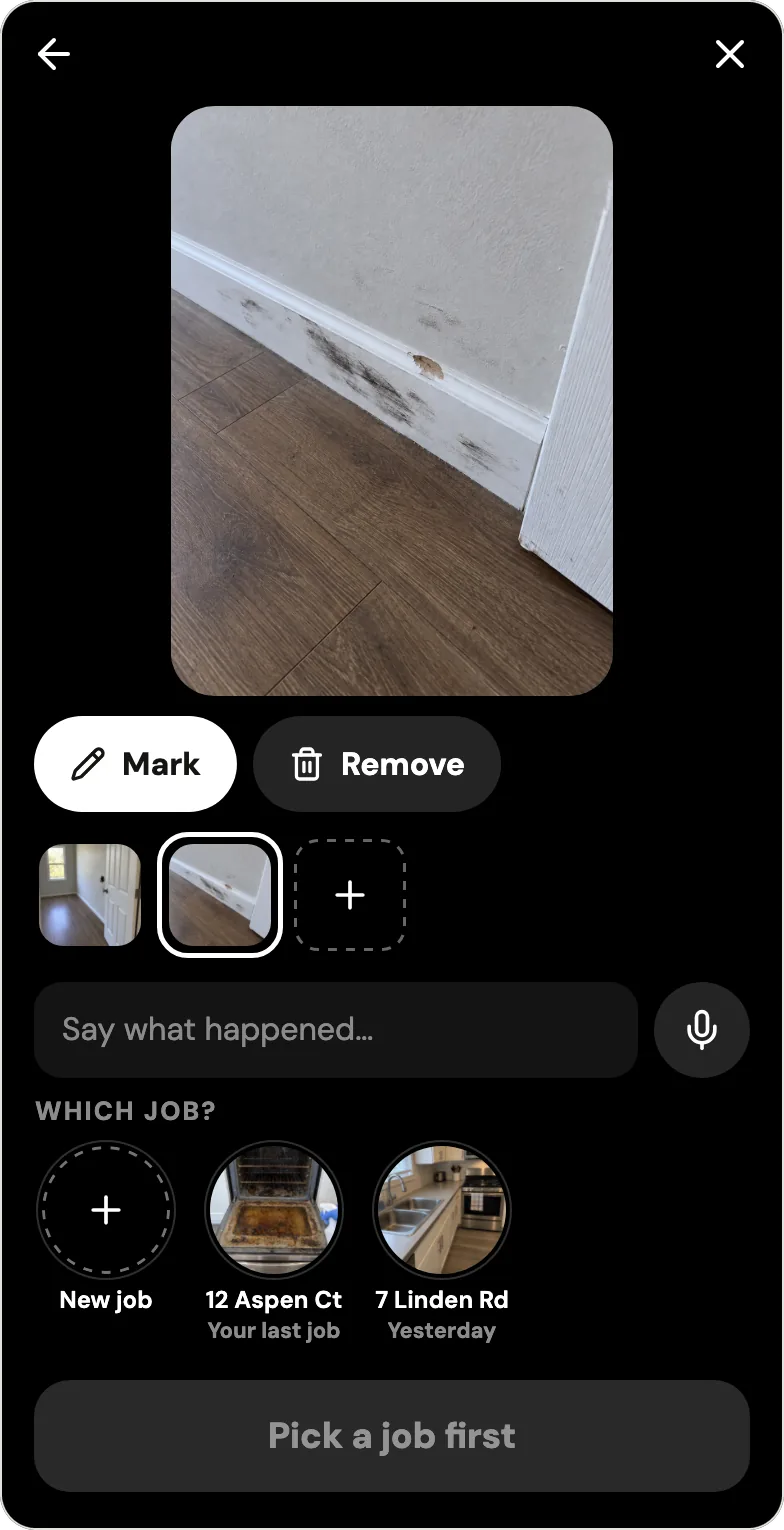
Handle, as an example. At a house Handle doesn't know yet, Handle doesn't guess: after the photos it asks Which job? with nothing preselected, and the button reads Pick a job first until the cleaner picks one or taps New job. Handle picks a job by itself only when the phone is at that job's address or the cleaner just posted to it from the same spot (how photos land on the right job). In a basement with no signal, Handle saves the photo on the phone first and it goes up once there's signal and Handle is open, keeping the time it was taken (no signal).
What should you send the client, and when?
A cleaning business should send photos the same day, before the house is lived in again: to first-time, deep-clean and move-out clients, to clients who weren't home, to anyone who asks, and whenever something broke or couldn't be done. Regular clients rarely need photos after every visit; keep those on file.
One cleaning company described the habit on r/cleaningbusiness: "we only send them when it's a first clean, move-out, or someone asks. Most regular clients are trust-based, but the photos help when there's a complaint" (r/cleaningbusiness, February 2026).
| Situation | What to send | When |
|---|---|---|
| First clean or deep clean | Two or three pairs of the rooms they care about, plus a line on anything you couldn't do | Same day |
| Move-out | Every room and appliance, as one file the client can forward to a landlord | Same day |
| Something couldn't be done | The photo and the reason: "Hard water on the shower head is set in; not part of a standard clean." | Before you leave |
| Something broke | A photo and a call, or a note if they're out | Same day |
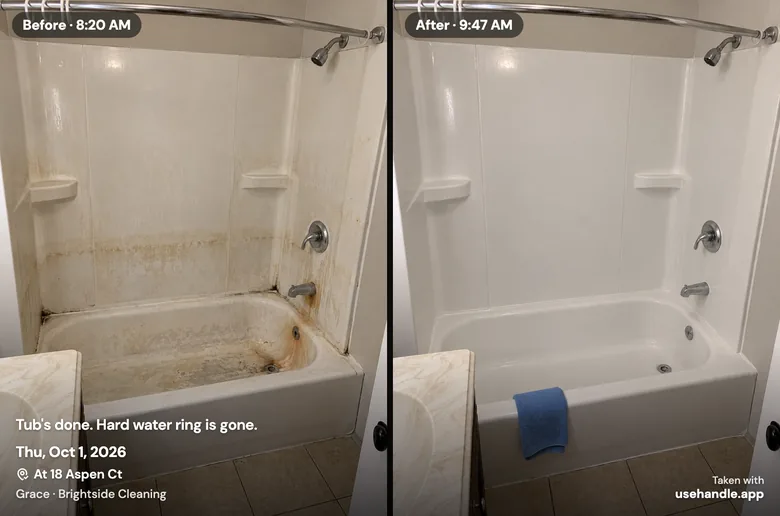
Handle, as an example. Open a before and after pair in Handle, tap the share button, then Send photo: Handle makes one picture of the two, each half labeled with its own time, with your words, the date and who took it written on it, and you send it from your own phone by text, WhatsApp or email (send a photo). The job line ("At 18 Aspen Ct") appears only when the photos were taken at or near the job; otherwise the picture shows the time only. For a move-out, the owner sends the whole job as one PDF: Text to the client when the job has their number, or Send PDF by email (send the whole job).
A client says "you missed a spot": what do you do?
When a client says a cleaner missed a spot, answer the same day: ask which item, check it against the scope they were sent, and compare it with your after photo. If it was on the list or plainly missed, go back inside your re-clean window; if not, say so kindly and offer it as an add-on, in writing.
- Answer fast, by phone if you can. Thank them, then ask which room, which item, and for a photo.
- Check the scope. The $400 deep clean above turned on this step.
- Check your after photo of that spot, and say what it shows, without arguing.
- On the list, or obviously missed: go back. ISSA Residential tells homeowners the crew should return "if it is something that was obvious or really matters", and for small things to "call the office or leave a note to ensure that it is not missed again" (ISSA, December 2025).
- Not on the list: offer it as an add-on, priced before the next visit.
- If they refuse the re-clean ("I offered to come reclean but that's not enough for her", one cleaner wrote, r/cleaningbusiness, July 2026), offer what your written policy allows in a text or email. A bank looks for that offer later.
- Photograph the fix and send it.
Sometimes speed beats proof. A builder-clean company in Sydney, outside the US: "even with proof sometimes it's faster to send someone back for a touch-up than turn it into a back-and-forth" (r/cleaningbusiness, May 2026).
Handle, as an example. At the re-clean, photograph the spot as you find it, clean it, then open that photo and tap Take after: the camera shows the first photo faintly over the live view so you line up the same spot (before and after). Send photo sends the pair as one picture, "Before · 10:02 AM" and "After · 10:20 AM", with your words.
A client says "you broke it", or it was already damaged: what holds?
When a client says a cleaner broke something, what holds is a photo of the item taken on arrival, before anyone touched it, with a few words, plus a same-day report if something did break. Without an arrival photo, the talk turns to value and goodwill, not proof. This isn't legal or insurance advice.
In March 2026, an owner posted about an antique that snapped while being dusted: "We suspect it was previously broken, repaired" (r/cleaningbusiness). Without a photo of the old repair from an earlier visit, that stays a suspicion. One reply: "If you don't have insurance, you may be liable to replace or repair the item unfortunately" (same thread).
- Fragile, old or already repaired items: photograph them at the first clean, close up, with words ("Glued crack on the left handle, already there").
- If something breaks: photograph it where it broke, before you clean up, and tell the client the same day. "You break something if the customer isn't home you leave a note," as one reply put it (r/cleaningbusiness, October 2026).
- Keep the first message to facts. Cleaning Business Life's damage episode lists "why technicians should never promise payment or admit fault on the spot" among its points, next to repair versus replacement and "determining the value of older items" (episode 223). Let the owner follow the policy, and call your insurer before you pay or admit fault on anything costly.
Car detailers fight the same "it was already there" argument over paint and seats; their intake walkaround and waiver are in pre-existing damage in car detailing.
Handle, as an example. Tap Mark on the arrival photo to circle the damage and write a few words on it. The photo itself never changes: marks are a layer over it, and the viewer says "Marked by … · Hold the photo for the original". Only the person who posted a photo can change its words (the owner can't rewrite them), and a note stays as it was written. A photo that reached Handle more than 10 minutes after it was taken, say from a basement, says "Reached Handle at …" in its details; the time on it stays the time it was taken.
The client disputed the charge with their card: what do you send?
When a cleaning client files a chargeback, answer before your processor's deadline with one short file: the scope the client saw when booking, two to four dated after photos of the disputed rooms, your message thread, and the re-clean or refund you offered under your policy. Banks don't open links. This isn't legal or financial advice.
First read the reason. Visa's dispute guide for merchants (dated October 2026) files a service that never happened under 13.1, Merchandise/Services Not Received, and asks for "records, service logs, or signed acknowledgement showing that the cardholder received the service". For a house clean, the closest records are usually the appointment confirmation, the client's messages and your dated after photos. Services that "were poorly performed or did not match the agreed scope" go under 13.3, where the evidence is the scope shown before the purchase and the fix you offered; "Internal quality or inspection records are supporting only" (Visa guide, pp. 55–62). Stripe calls the two "Product not received" and "Product unacceptable" (Stripe dispute categories). Your photos back up the list; they don't replace it.
| As of October 2026 | Stripe | Square |
|---|---|---|
| Time to respond | "usually 7 to 21 days, depending on the card network" | "a short seven-day window" |
| File limits | "combined maximum of 4.5 MB"; Mastercard: 19 pages | "no larger than 5MB and no longer than 15 pages"; HEIC, JPEG, PDF, PNG or TIFF |
| Leave out | Links, audio or video files, "Requests to call or email for more information" | Highlighting: the bank's copy is "in black and white" |
Sources: Stripe ("You've only one opportunity to submit your response") and Square, both opened October 17, 2026. Visa's guide adds: "Providing more documents does not necessarily improve the outcome" (p. 7).
The cardholder has rules too, under federal law. The FTC tells consumers that a billing-error letter must reach the card issuer "within 60 days after the first bill with the error was sent to you", and that one condition for withholding payment over poor quality is "You must have tried to resolve the dispute with the seller first" (FTC, opened October 2026). A chargeback through Stripe or Square runs on the card network's rules and deadlines, so don't argue the cardholder's dates in your response; do put in the file a thread showing the client never contacted you, or turned down your re-clean.
Handle, as an example. The owner's job PDF is a file frozen on the day it's made, each photo stamped with its time and who took it. Handle shrinks the photos to aim for under 10 MB so the file goes by email or chat, which can still be over Stripe's 4.5 MB: take photos out with × until only the disputed rooms are left, put a two-line summary in the PDF's note ("Booked: move-out clean, list sent Sep 28. Re-clean offered Oct 4 by text."), then email it to yourself and check the size. Send it with the booking confirmation and screenshots of the thread themselves: the note points to them, it doesn't replace them. The stamped pair alone is one JPEG. On a black-and-white copy, words carry better than color: in our own test (October 2026), a marked photo turned to grayscale kept its outlined words readable while a yellow circle faded to pale gray. On white tile, write the words and pick red or black.
Will photos hold up in small claims court?
Photos of a cleaning job help in small claims when a judge can see, on a printed copy, what they show, when they were taken and who took them. They don't decide a case alone: the scope list and your messages count too. Rules differ by state; this isn't legal advice.
Print, don't scroll. In California, the San Mateo County Superior Court's self-help page says: "Generally, you should have at least 3 copies of all evidence you intend to present at trial," and "Another copy goes to the Judge" (San Mateo Superior Court, opened October 2026). Bring the scope list, the thread, and the after photos with the time printed on them, in date order. A wide shot from the doorway answers "is that my house?"; the time and who took it answer "was that the day?".
Handle, as an example. Each photo in Handle shows who took it and when; its details say "The time and place come from the phone the moment it was made" for a photo from Handle's camera, or "The date comes from the file itself" for one from the camera roll. The job PDF prints on US Letter, one photo or pair per page, "3 of 9" at the foot. The stamp never says "verified" or shows a map, and Handle reads the phone's location only at the moment of a photo, a voice note or a note (what the location lines mean). A sent photo carries no hidden data (EXIF), so if you might need a camera's original file with its metadata, take that one with the phone's own camera too.
What can't photos prove?
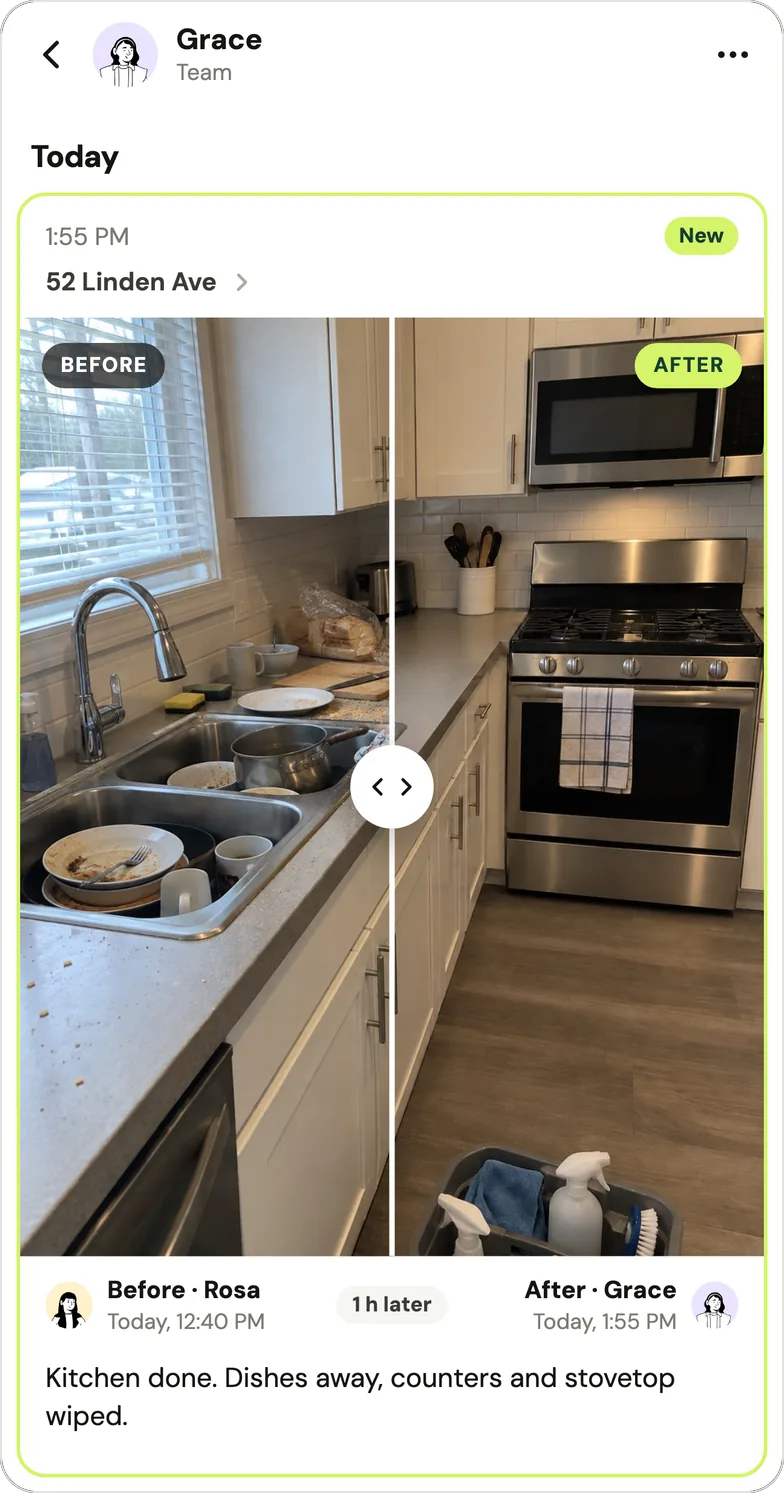
Photos of a cleaning job can't prove taste, what happened after the crew left, or a task that was never on the list. A clean kitchen at 2:40 PM says nothing about the kitchen at 8 PM, and no photo of baseboards helps if the client booked a standard clean and expected a deep one.
Having photos isn't the same as winning. In 85 owner comments from Reddit and trade forums (2023 to 2026) that Handle's team collected and tagged in September 2026, the tag "you damaged it / you didn't do it" was the most common complaint, on 24 of them, and several of those owners had before photos and refunded anyway. That's one sample across several trades, not a rate for cleaning businesses.
One owner's answer is to drop the client rather than build a case: "If a client doubts you came or did a full clean, they need to be an EX client. Full stop." (r/cleaningbusiness, March 2026). And photos often go unused: "after uploading several hundred photos during that job no one ever needed to use them as proof that I did the job either" (the same cleaner, r/cleaningbusiness, May 2026). That's the case for shooting the dispute set, not everything.
Phone camera, cleaning software or a job photo app?
A phone camera and a text are enough for one cleaner with a few regular clients. Cleaning business software fits when you need booking, payments and checklists each cleaner checks off. A job photo app fits a crew of two or more whose photos must land on the right client's job, with who took each and when.
| Phone camera and texts | Cleaning software (example: ZenMaid) | Job photo app (example: Handle) | |
|---|---|---|---|
| Checklists per visit | No | Pro: "Digital checklists for your appointments"; each checked item shows who and when | No |
| Booking and payments | No | Starter: "Online payments with Stripe and Square and invoicing" | No |
| Every cleaner's photos on the client's job | No, each in their own camera roll | Not on the two pages below; ask ZenMaid | Yes, with who took each and when |
| Time written on the photo you send | No | Not on the two pages below | Yes, plus the job when the phone was there |
| Cost | Free | Plans listed from $19 a month before team size; 14-day trial | Free for your whole crew: no trial, no card, no per-person fees |
ZenMaid facts as of October 2026, from zenmaid.com/pricing (the price changes with the number of cleaners and office staff) and its checklist help article, which says that when a cleaner checks off an item, "the system displays the cleaner who completed it along with the exact time it was marked".
Handle, as an example. Handle is a free iPhone and Android app for small field crews: it keeps the crew's job photos, notes and voice notes together, job by job, on every phone in the crew. Cleaners join from a text the owner sends; everyone on the crew sees every job, and a client sees a photo only when someone sends it (who sees what). Handle (usehandle.app) is not Handle.com or Handle by Texada. More on Handle for cleaning crews, and on a group text versus a job photo app.
When Handle is not for you
Handle, our app, is not for you if you need a checklist each cleaner checks off, proof of arrival from GPS clock-in, on-screen sign-off, booking and invoices, an iPad at the office, or a page the client opens (Handle has no customer link). Handle keeps a crew's photos on the right job; it doesn't run the office. What fits better for each, and when a phone alone is enough:
- A checklist each cleaner checks off. Handle has none. ZenMaid Pro lists "Digital checklists for your appointments", and each checked item records who checked it and when (as of October 2026, pricing, help center); other cleaning software has checklists too.
- Proof of arrival from GPS clock-in. Handle doesn't clock anyone in; it reads the phone's location only when a photo, voice note or note is made. ZenMaid Pro lists "Mobile app with cleaner GPS tracking" (as of October 2026, pricing).
- A client who signs off on a screen, or a client page. Handle has no signatures and no customer link. You send photos or the PDF from your own phone.
- Booking, scheduling, invoices or payments. Handle doesn't do them; keep your booking software and use Handle alongside it for the photos.
- An iPad at the office. Handle runs on iPhone and Android phones; there's no iPad version.
- One cleaner, a few regulars. The phone's camera and a text are enough.
Questions owners ask
How do cleaners prove they actually cleaned?
With three records: the scope list the client was sent, after photos of the rooms taken before the crew left with the time on each, and a written thread of what was said and offered afterward. Photos answer "you never cleaned it"; the scope list answers "you missed the baseboards"; a re-clean offered in writing answers "it's not clean enough".
How long do I have to respond to a chargeback?
Days to a few weeks, so start the day the notice arrives. Square gives sellers "a short seven-day window" (Square support, October 2026), and Stripe says the window is "usually 7 to 21 days, depending on the card network", with one chance to submit (Stripe docs, October 2026). Your processor's notice gives the exact date. This isn't legal or financial advice.
Should a cleaning business offer refunds or re-cleans?
A common policy is a free re-clean of missed items when the client reports them within a short window: one owner on r/cleaningbusiness allows 24 hours and gives no refunds (July 2026), and Queen of Maids allows two business days (its service guarantee, October 2026). Whatever you choose, put it in writing before the first clean: Visa's merchant guide lists "Records showing a repair, replacement, or refund was offered in line with your disclosed policy" as evidence in a quality dispute (Visa, p. 61, October 2026). This isn't legal or financial advice.
What should a cleaner do after breaking something in a client's home?
Photograph it where it broke, tell the client the same day (a call, or a note if they're out), and don't promise payment on the spot. Then follow your written damage policy: repair where you can, otherwise pay a fair value for the item's age, and talk to your liability insurer before you pay or admit fault on anything costly. This isn't legal or insurance advice.
Do house cleaners need to be bonded?
Rules vary by state and city, so ask a local insurance agent. ISSA Residential, the residential cleaning group of the trade association ISSA, tells homeowners to ask for liability insurance and calls bonding "a false sense of security" (ISSA FAQ, December 2025). This isn't legal or insurance advice.
How long should I keep cleaning photos?
At least until the charge can no longer be disputed and any deposit fight is over. Ask your processor how long that is: the FTC's 60-day limit for a cardholder's billing-error letter (FTC, opened October 2026) is not the only clock, because card networks set their own dispute deadlines. Handle, as an example, keeps a crew's jobs and photos as long as the crew exists. This isn't legal or financial advice.
Is there a free app to keep cleaning photos with the time and who took them?
Your phone's own camera is free, but each cleaner's photos stay in their own camera roll and the picture you text has no time written on it. A job photo app keeps the whole crew's photos on the client's job. Handle, for example, is free for your whole crew on iPhone and Android: no trial, no card, no per-person fees. Each photo lands on the client's job with who took it and when, and you send it with the time written on it.
Every photo, on the right job.
Handle is free for your whole crew: no trial, no card, no per-person fees. On iPhone and Android.